Gadgets that make pole dancing safer and more effective
 Save
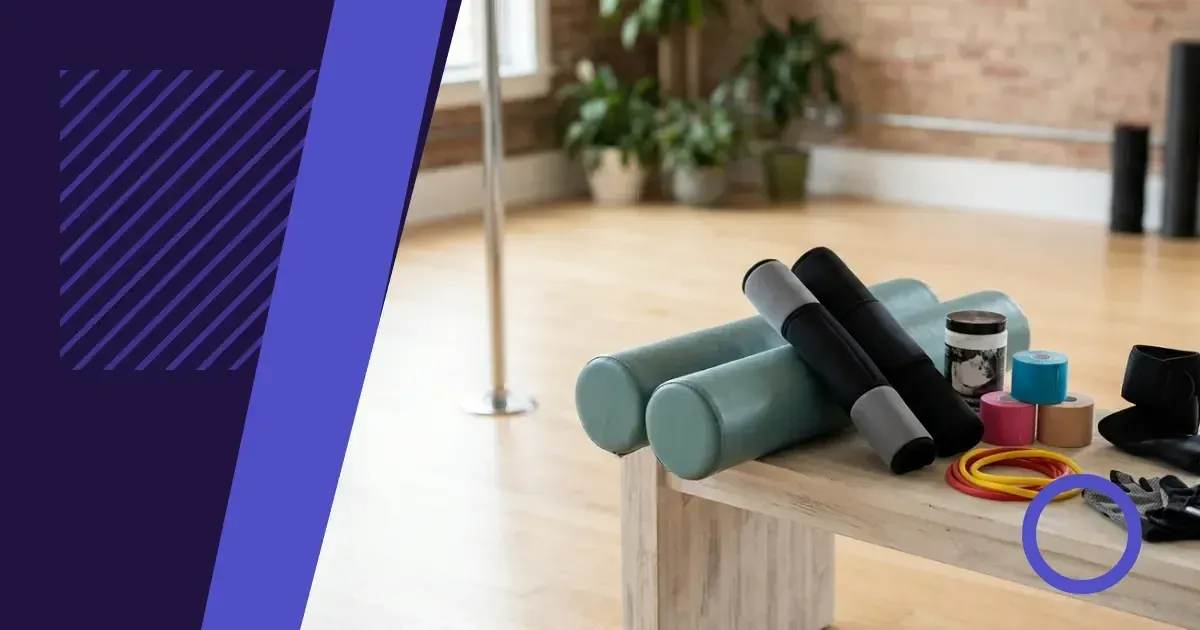
Most pole dancers train with nothing more than a pole and bare skin, but a handful of gadgets solve real problems. Cumbria Pole Art covers the tools that improve grip when your hands slip, protect you during inversions and help you measure progress without guessing.
Crash mats reduce the risk of falling onto hard floors
A crash mat sits under or around the pole and cushions you if you lose your grip. The thicker the mat, the more impact it absorbs. Most are folding designs that store flat against a wall.
Place the mat so it catches you during the moves you find hardest. If you are drilling an inversion, centre the mat under the pole. If you are working on spins that swing you outward, a larger mat or two mats side by side give you more coverage.
Crash mats do not replace technique. They buy you confidence to try moves that scare you, and they soften the occasional slip, but learning to bail safely is still the priority.
Grip aids give you traction when your hands sweat or the pole is too smooth
Grip aids fall into two groups: those that dry your skin and those that add friction. Chalk-based powders absorb moisture; rosin and similar products create a tacky layer between skin and metal.
If your hands sweat mid-session, a quick wipe with a microfibre towel followed by a light dusting of dry grip works faster than waiting for your skin to cool. If the pole itself is slippery because it has been over-cleaned or the coating has worn smooth, a friction aid applied to the pole gives you something to hold.
Worth remembering: different grip aids suit different pole finishes. Powder grips work on chrome and stainless steel; tackier products can leave residue on brass or powder-coat poles. Test a small amount first if you are using a shared or rented pole.
Liquid chalk vs dry powder
Liquid chalk dries on your hands and lasts longer than loose powder, but it takes a few seconds to set. Dry powder gives you instant traction and washes off easily, but you will reapply it more often. Both do the same job; the choice is whether you want to reapply frequently or wait for the product to dry between attempts.
Ankle weights add resistance to leg lifts and holds
Ankle weights strap around your lower leg and make every lift harder. They build the strength you need for moves where your legs are unsupported—climbs, leg hangs and anything that asks you to hold your knees to your chest.
Start light. Half a kilogram per ankle is enough to feel the difference without throwing off your balance. Add weight only when the current load no longer challenges you after a full set.
Take them off for spinning moves and anything that involves momentum. The extra weight changes how fast you rotate and where your centre of gravity sits, and that makes familiar moves feel unpredictable.
Resistance bands strengthen the muscles you use for pulling and holding
A resistance band is a loop or strip of elastic that you pull against. Anchor one end to a sturdy point and pull the other end toward you, or loop it around both hands and pull them apart.
Pole dancing asks a lot of your shoulders, lats and core. Rows, pull-aparts and banded dead-hangs all train those muscles without a pole. If you cannot yet hold your weight in a dead hang, a band looped over the pole and under your feet takes some of the load and lets you build time in the position.
In practice: bands come in different resistances, usually marked by colour. A lighter band is harder to see progress with, but it lets you work on form. A heavier band tires you faster and shows strength gains sooner. Keep both.
Foam rollers release tight muscles after training
A foam roller is a firm cylinder you lie on and roll slowly across. It presses into the muscle and releases knots that build up after repeated moves.
Roll your quads, hip flexors and the sides of your thighs after a session that involved a lot of leg grips. Roll your lats and the muscles around your shoulder blades after a session heavy on pull-ups or holds. Move slowly—one roll every few seconds—and pause on any spot that feels tight.
Foam rolling is uncomfortable when you hit a sore area, but it should not hurt sharply. If it does, ease off the pressure by shifting more of your weight onto your hands or feet.
Progress trackers help you see what is changing over time
Progress trackers range from a notebook where you log which moves you nailed to apps that time your holds and count your reps. The format matters less than the habit of writing it down.
Track the moves you are working on, how long you held them and how the session felt. A month later, you will see patterns: which moves improved, which days you trained best, where you are stuck. That clarity helps you decide what to drill next and when to take a rest day.
Some apps let you film yourself and overlay the video with notes. That is useful for spotting where your form breaks down, but a simple list of moves and dates does most of the work.
Pole dancing asks for very little equipment, but the right gadget solves a specific problem
You do not need gadgets to train, but the ones listed here all address a real gap: grip that fails, falls that hurt, muscles that do not recover and progress you cannot measure. Start with the problem you are actually facing, then add the tool that fixes it.
If you want to understand how pole diameter and mode affect every move, read choosing pole diameter. If you are setting up at home for the first time, how to start pole dancing at home walks through the steps before your first session.
Frequently asked questions
Do I need a crash mat if I train at home?
You do not need one, but it makes trying new inversions and aerial moves less intimidating. A mat cushions you if you slip, and that confidence often helps you commit to the move properly.
Which grip aid works best for sweaty hands?
Dry powder or liquid chalk both absorb moisture quickly. Liquid chalk lasts longer once it dries, but powder gives you instant traction if you need to reapply mid-session.
Can I use ankle weights during spinning pole moves?
It is not recommended. The extra weight changes your rotation speed and centre of gravity, which makes familiar moves feel unpredictable and harder to control safely.