Three flexibility ranges that decide which pole moves you can attempt
 Save
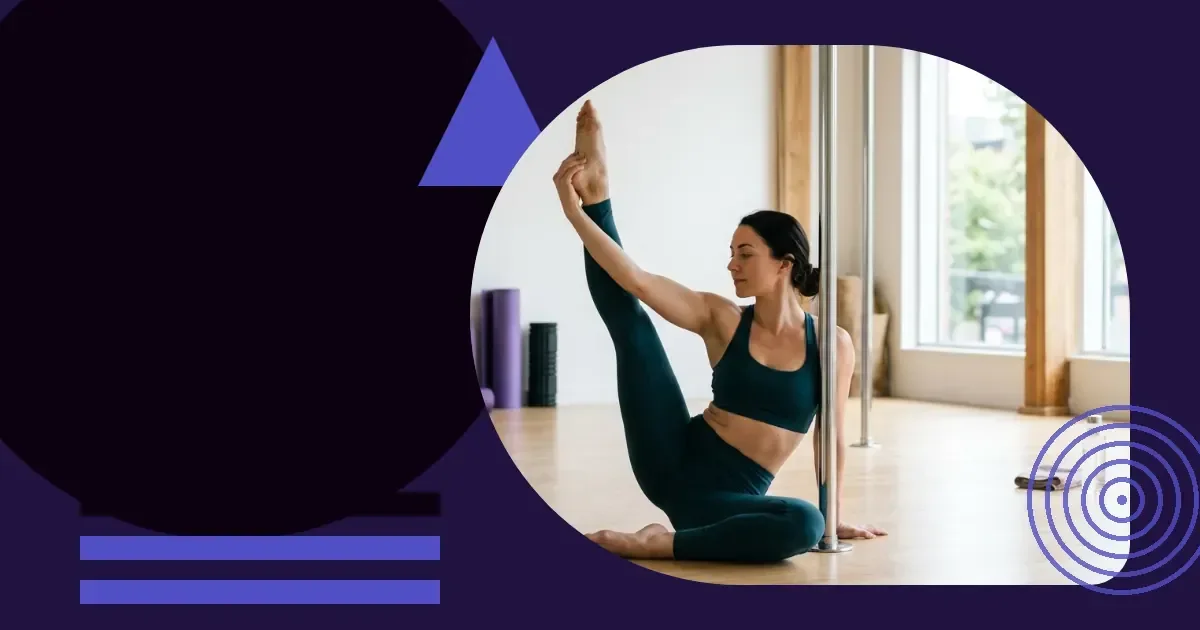
Flexibility determines which pole moves you can safely attempt, but not every move needs the same kind. Hip flexibility gates splits and high leg holds; shoulder flexibility controls how far you can reach behind you in aerial moves; back flexibility decides whether bridges and backbends are within reach. Cumbria Pole Art walks you through the three main ranges pole dancers work on, the moves each one unlocks, and how to stretch for them without forcing progress.
Hip flexibility unlocks splits and high leg holds
Splits require your hamstrings and hip flexors to lengthen enough that your legs can extend in opposite directions while your pelvis stays square. On the pole, that range shows up in moves like the jade split, the front split dismount, and any hold where one leg extends above shoulder height while the other anchors you.
A seated forward fold tells you where your hamstrings are now. Sit on the floor with both legs straight in front of you and reach towards your toes. If your fingers reach past your ankles, you have enough hamstring length for most beginner and intermediate moves. If you can fold your torso flat onto your thighs, splits become reachable with consistent practice.
Hip flexors work the opposite direction. A low lunge stretches them: kneel on one knee, step the other foot forward, and let your hips sink towards the floor. Tightness in the front of your back hip means that leg won't extend fully behind you yet, which limits how far you can open in a split or how high you can lift your back leg in a standing split on the pole.
How much range you need before attempting splits
You don't need full splits to start training them, but you do need enough range to enter and exit the position without your muscles seizing. If you can comfortably hold a low lunge with your back knee on the floor and your hips an inch or two above the ground, you're ready to begin working towards a split on the pole with a crash mat underneath.
Shoulder flexibility controls how far you can reach in aerial holds
Shoulder flexibility shows up in moves where your arm extends behind your back or overhead while bearing weight. The ayesha, the iron X, and any move where you grip the pole behind your shoulder line need shoulders that can externally rotate without straining.
Stand with your back against a wall and raise both arms overhead. If your elbows and the backs of your hands touch the wall without your ribs flaring forward, your shoulders have enough extension for most overhead pole work. If your lower back arches away from the wall to get your arms up, your shoulder extension is limited, and forcing it in an aerial move will shift the load onto your lower back instead.
Internal rotation matters too. Lie face-down and try to clasp your hands behind your back. If your hands meet easily between your shoulder blades, you have the internal rotation needed for moves like the crucifix and the twisted grip shapes that advanced pole work uses.
Stretching shoulders safely for pole
Shoulders are looser than hips but easier to injure if you push them cold. Warm up with arm circles in both directions, then use a resistance band or a towel to pull one arm gently across your body and overhead. Hold each stretch for twenty to thirty seconds and stop if you feel a pinch in the joint itself rather than a pull in the muscle.
Back flexibility decides whether bridges and backbends work
Backbends and chest stands need your thoracic spine to extend while your lumbar spine stays relatively neutral. Forcing a backbend from your lower back alone causes compression and pain; a bendy thoracic spine spreads the curve across more vertebrae and keeps the position sustainable.
A simple test: lie face-down and press your chest off the floor while keeping your hips down. If your chest lifts a few inches and you feel the effort between your shoulder blades rather than in your lower back, your thoracic spine is mobile enough to start learning bridges. If the sensation sits in your lower back or you can barely lift at all, your thoracic spine is stiff, and you'll need to work on extension before attempting anything that bends you backwards on the pole.
Chest openers work faster than passive backbends. Kneel in front of a chair or a bench, place your elbows on the seat, and let your chest sink towards the floor while keeping your hips over your knees. This stretches the muscles between your ribs and opens your thoracic spine without loading your lower back.
Steps to stretch for pole without forcing progress
- Warm up with five minutes of movement that raises your heart rate—marching on the spot, arm circles, or a few spins on the pole in static mode.
- Hold each stretch for twenty to thirty seconds, release, and repeat twice. Stretching cold or holding a stretch for several minutes at the start risks straining a muscle before it's ready.
- Focus on one area per session. A full-body stretching routine dilutes your effort; picking hips one day, shoulders the next, and back the third lets you work each area thoroughly.
- Track your range every two weeks by repeating the same test—a forward fold, an overhead reach, or a chest lift. Progress shows up in millimetres, not breakthroughs.
How conditioning and flexibility work together
Flexibility gives you range; strength lets you control it. A loose hamstring that can't hold you in a split will fold you into the position and dump you out of it just as fast. Building strength for pole dancing covers the muscle groups that keep you stable once your flexibility gets you into a move.
Conditioning also protects the flexibility you already have. If you stretch your hips but never strengthen your glutes and hip flexors, those muscles weaken and your range becomes passive—you can get into the position, but you can't get out of it safely or hold it under control.
Which moves need which kind of flexibility
| Move | Primary flexibility demand | Range you need |
|---|---|---|
| Jade split | Hips (hamstrings and hip flexors) | Front split or close to it |
| Ayesha | Shoulders (external rotation) | Arms overhead against a wall without arching |
| Bridge | Back (thoracic extension) | Chest lift from prone without lower back pain |
| Extended butterfly | Hips (adductors and internal rotation) | Knees resting towards the floor in a seated butterfly |
Common mistakes that slow flexibility progress
Bouncing in a stretch triggers your muscles to contract protectively rather than lengthen. A slow, steady hold signals safety; a bounce signals threat, and your body responds by tightening up.
Stretching only after pole sessions leaves your muscles too tired to lengthen properly. Flexibility work needs your muscles fresh enough to engage slightly as they stretch, which is why a short warm-up followed by dedicated stretching works better than treating stretches as a cooldown.
Comparing your range to someone else's sets you up for frustration. Bone structure, muscle insertion points, and your training history all affect how far you can stretch and how fast you progress. Someone with naturally open hips might reach a split in weeks; someone with tight hip flexors might need months. Both outcomes are normal.
When tightness might be something else
If a stretch causes a sharp pinch, a burning sensation, or pain that doesn't ease when you back off, stop. Muscle tightness feels like a pulling or tugging that lessens as you hold the stretch; joint pain or nerve pain doesn't improve with time in the position. Continuing through joint pain risks injury that will set your flexibility back further than missing a session ever could.
Make stretching part of your weekly routine
Pick three days a week and spend fifteen minutes on flexibility after a short warm-up. Spreading those sessions across the week—Monday, Wednesday, Friday—gives your muscles time to recover between stretches, which is when the actual lengthening happens.
Keep a notebook or a photo record of your starting range and check in every month. Progress happens too slowly to notice session to session, but a photo from eight weeks ago will show you how far you've come when the day-to-day gains feel invisible.
Download PDF: Pole flexibility training checklist PDF, 29 KB
Further reading
Frequently asked questions
How long does it take to get flexible for pole dancing?
Progress depends on your starting range, how often you stretch, and your bone structure. Most people notice a difference in hip flexibility within four to six weeks of consistent stretching, while shoulder and back flexibility can improve faster because those joints are naturally looser. Reaching full splits can take several months to over a year.
Should I stretch before or after pole dancing?
A short dynamic warm-up before pole work prepares your muscles without tiring them. Save deeper stretching for after your session or on separate days when your muscles are warm but not fatigued. Stretching cold or when exhausted increases injury risk and limits how much range you can safely work on.
Can you pole dance if you're not flexible?
Yes. Many beginner and intermediate moves need strength and grip more than flexibility. Spins, climbs, and seated holds work with limited range. As you progress, certain advanced moves will require specific flexibility, but you can build that over time while still training other skills.