Four hand positions that fix your pole grip technique
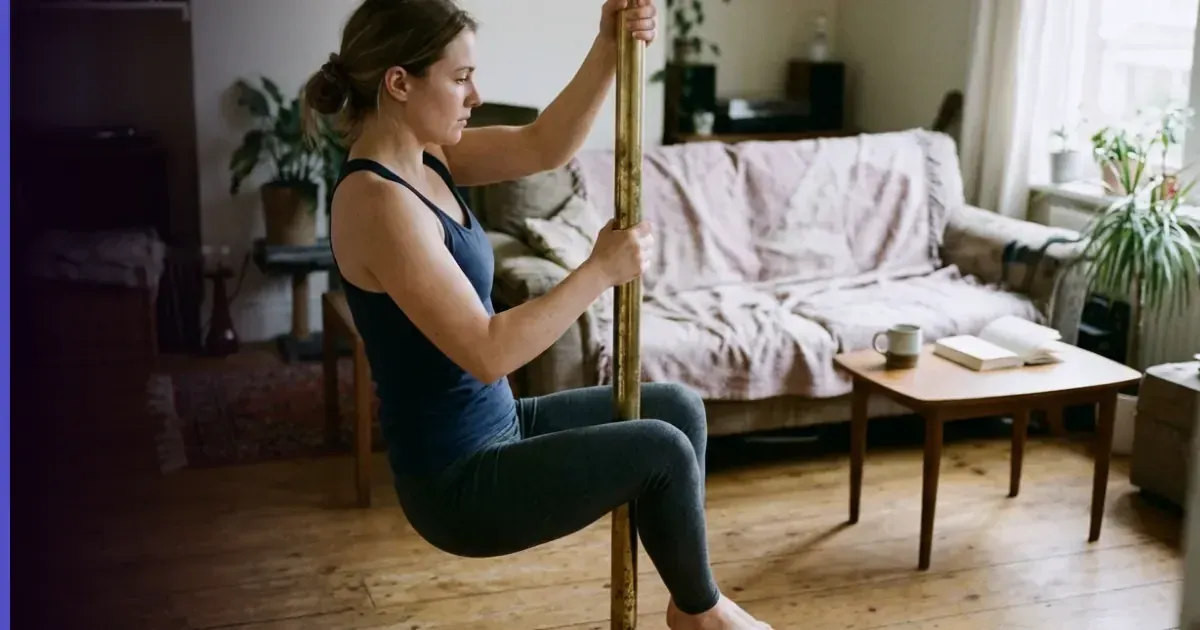 Save
Your hands slip because the pole is sitting in your palm rather than in the web between thumb and index finger, and because you are squeezing where you could be pressing. That single contact point is the whole of pole grip technique in one sentence. Below, Cumbria Pole Art sets out four hand positions that cover the holds you meet first, a short way to tell a placement problem from a skin problem, and a routine you can run at your next session.
Pole grip technique starts where the pole meets the hand
A hand holds a pole in one of two ways: it presses, or it hooks. Pressing works when the pole sits against the web of the hand and the fingers wrap the far side. Hooking works when the hand closes over the top with the wrist above the pole. Everything else, from the squeeze to the forearm burn, is a workaround for one of those two shapes being wrong.
Watch where the pole lands the next time you take a hold. If it crosses the middle of your palm, the fingers have nothing to wrap and the hand clamps to stay put. Move the pole back into the web and the same hold asks far less of you.
Pole grip technique begins with four hand positions
Studios name these differently, so learn the shape rather than the label. Four positions will see you through the holds you meet first.
- The pinch, sometimes called a split grip. The pole sits in the web between thumb and index finger, with the thumb on one side and the fingers on the other. It is the position that lets you push away.
- The cup. The hand comes over the top of the pole, palm down, fingers over the far side. Strong for pressing the body away, weaker when you hang from it.
- The true grip. Fingers wrap one side, the thumb wraps the other and points up the pole. This is the hold for climbs and anything overhead.
- The thumb-down hold. The same wrap as the true grip, with the thumb pointing down the pole. It keeps the wrist free when the body turns away from the hand.
A slipping hand is a pole grip technique problem before it is a strength problem
Rule out the plain causes first. A hold that gives way in the same spot every time is telling you something about how it was set up, not about how strong your fingers are.
The hand comes before the skin
- The pole crosses the palm instead of sitting in the web.
- The fingers are straight, so the hand clamps rather than wraps.
- The hold is overhead, where a true grip does the work and a cup cannot.
What sits on the hands matters as much as the placement
Damp skin, fresh moisturiser or a sleeve over the contact point will slide however well the hand is placed. Wash and dry your hands before you start, and keep lotion off them on training days. When sweat is the recurring culprit, the fixes in dealing with sweaty hands on the pole sit alongside the placement work here.
Some grip arrives on its own with time on the pole
Skin adapts to the contact. The points on your hands that take the load thicken as you train, and holds that felt desperate when you started begin to sit still. That change comes from repeated contact rather than from anything you buy, and rushing it does not work.
The quieter half of the progress is learning to place rather than grab. Bare skin at the contact point helps, and what to wear for pole dancing explains which areas need to stay uncovered.
Grip aids buy time and hide the problem underneath
An aid is neither cheating nor a cure. It adds tack or takes moisture away for the length of a session, which is enough to finish a combination you have already learned. Use it to get through the set, then take it off and find out what the hold does without it.
| Aid | What it does | Where it earns its place |
|---|---|---|
| Resin | Adds tack to the skin so the hand bites on the pole | Long holds where the hand is already placed well |
| Chalk or a drying agent | Takes moisture off the palms | Warm rooms and hands that run damp |
| Grip pads or gloves | Puts a textured layer between hand and pole | Repeating a move your skin cannot yet take |
A grip routine built on placement beats any product
Nothing here needs equipment. Run the steps in order and notice what changes.
- Wipe the pole down and dry it before you start.
- Wash your hands, dry them properly and leave the lotion in the bag.
- Warm the hands and wrists before your first hold.
- Set every hold in the web of the hand before you put weight through it.
- Write down which holds slipped and where the pole landed on each one.
Grip strength comes from holds, not from squeezing
The strength that keeps you on the pole is the strength that keeps the hand wrapped, and it grows by time spent in holds. Squeezing a soft ball trains a closed fist, which is not the shape you use on the pole. Hangs, supported holds and slow lowers build the hand under the load it actually meets. For the wider picture, building strength for pole dancing covers the muscle groups behind every move.
One hold tested properly changes more than a new grip aid
You do not need new kit to check any of this. One hold, examined closely, tells you more than a shelf of products.
- Give the pole a full wipe down before your first hold of every session.
- Pick one hold per session and move the pole back into the web if it has drifted.
- Save any grip aid for the last few attempts, then strip it off and repeat the hold bare.
- Film the hold that keeps failing and watch where the pole lands on your hand.
This article is general information about pole fitness. It is not medical advice, and pain or injury deserves a qualified professional.
Download PDF: Pole grip checklist for your next session PDF, 28 KB
Further reading
Frequently asked questions
Can you improve pole grip without buying anything?
Yes. Cleaning the pole, drying your hands and setting each hold in the web of the hand will change more than any product will. Time spent in holds does the rest.
Should a grip aid be part of every session?
No. Use one to finish a set you have already learned, then take it off and repeat the hold bare. If the hold only works with the aid on, the placement still needs work.
Does gripping harder keep you on the pole?
No. A hard squeeze tires the forearm without holding any better. Press the pole into the web of your hand and let the fingers wrap, so the hold does the work.